


Harcourt Street Dublin — A Local’s Guide to the Best Street in Dublin 2
Harcourt Street Dublin — A Local’s Guide to the Best Street in Dublin 2
There are streets in Dublin that tourists know and streets that Dubliners know. Harcourt Street sits in both camps simultaneously, which is part of what makes it worth understanding properly. Running south from the corner of St Stephen’s Green to the junction of Adelaide Road, it’s just over half a kilometre of Georgian architecture, layered history, decent pubs and genuine Dublin character. If you’re staying at Albany House, it’s essentially your front door.
This is a guide to the street and its surroundings — written for visitors who want to understand a neighbourhood rather than just tick off landmarks.
A Street Built in the 18th Century
Harcourt Street was laid out in 1777 by John Hatch, a property developer working under the direction of the Wide Streets Commission — the Georgian-era body that shaped much of Dublin’s planned street grid. The street appears on maps for the first time in 1784 and takes its name from Simon Harcourt, the 1st Earl Harcourt, who served as Lord Lieutenant of Ireland in the 1770s.
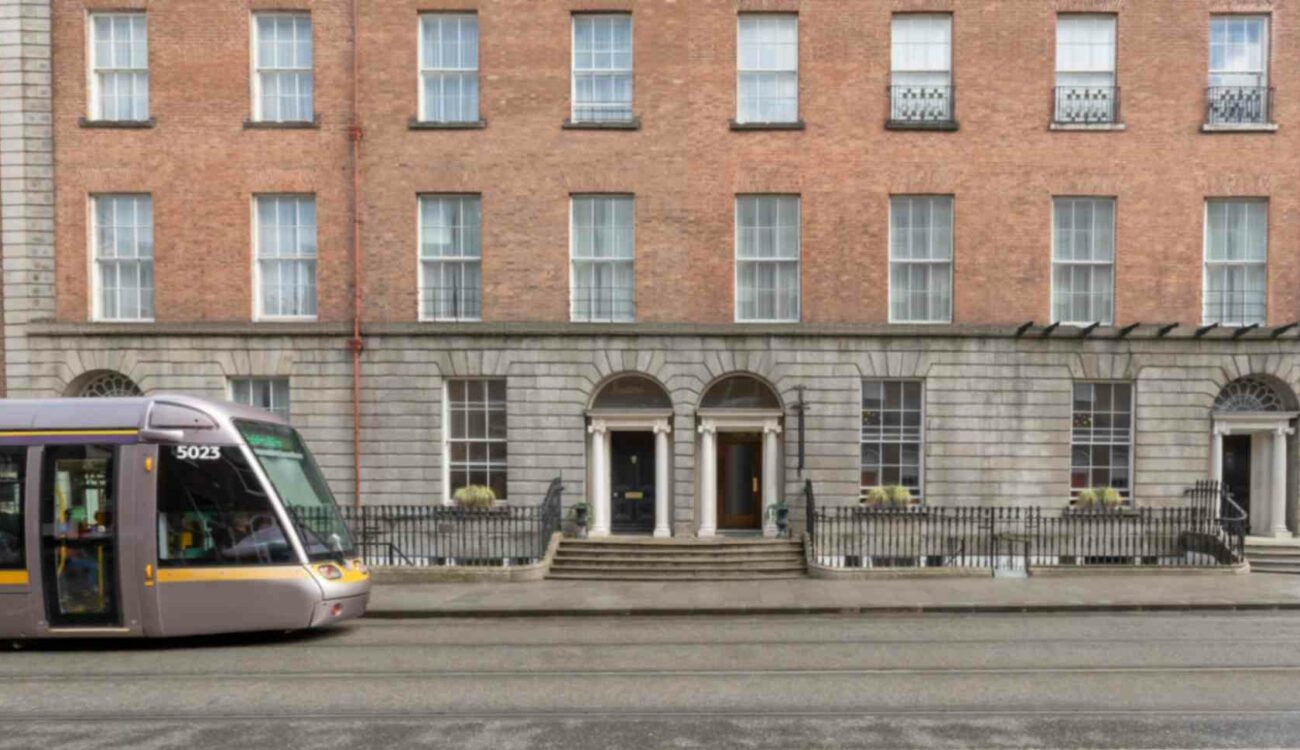
By 1843, the street had 72 houses — a long terrace of red-brick Georgian townhouses built to a consistent scale and proportion that still defines its character today. It was developed during the period when Dublin was one of Europe’s great cities — in the late 18th century, Dublin was larger than Boston or New York — and the architecture reflects that confidence and ambition.
What’s remarkable is how much of that original fabric survives. Harcourt Street remains one of Dublin’s most intact Georgian streets, with the terraces on both sides largely unbroken. Walk down it on a quiet morning and you can still see the city that Georgian Dublin intended — regular fanlit doorways, uniform rooflines, the proportion and rhythm of 18th-century planning at its most assured.
The Residents Who Shaped Irish History
A street of 72 Georgian townhouses accumulates history over two and a half centuries, and Harcourt Street has accumulated more than most.
The lawyer and Unionist politician Edward Carson — whose name remains one of the most contested in Irish political history — was born at number 4. A plaque marks the house. Carson became one of the most formidable barristers of his generation before entering politics; he is best remembered for the prosecution of Oscar Wilde and for leading the Ulster resistance to Home Rule in the years before the First World War.
Bram Stoker, the author of Dracula, lived for a period at number 16 — one of a number of connections between Harcourt Street and Irish literary life. The street was developed in the same period that Dublin was producing the writers, lawyers and politicians who would define Irish public life for the following century.
Number 6, a house with an extraordinary political biography, was the headquarters of Arthur Griffith’s Sinn Féin in the early 20th century. On 19 December 1918, the decision was made in this building to establish Dáil Éireann — the Irish parliament. The building was later home to Michael Collins when he served as Minister for Finance. In 1966, on the fiftieth anniversary of the Easter Rising, the state donated it to Conradh na Gaeilge in recognition of the Irish language organisation’s contribution to the nationalist movement; six of the seven signatories of the 1916 Proclamation had been members of Conradh.
John Scott, the 1st Earl of Clonmell — known as “Copper-Faced Jack,” a nickname earned through his notoriously corrupt legal career — lived at number 17, the largest house on the street. It was later known as Clonmell House. The gardens of Clonmell House, which extended behind the street, became in time the Iveagh Gardens.
The Station at the Bottom of the Street
At the southern end of Harcourt Street, near the junction with Adelaide Road, stands the former Harcourt Street railway station — a handsome Victorian building that was the terminus of the Harcourt Street line, which ran to Bray from 1859. The line was controversially closed in 1958, in what became one of the most lamented decisions in Irish transport history. The station building itself survived and has had several lives since — it now houses The Odeon, a bar and entertainment venue in the high-ceilinged former booking hall.
The story doesn’t end with closure, however. The Luas Green Line — Dublin’s light rail tram network — runs directly above the street, with a stop outside the old station building. The tram follows a route that shadows much of the original railway line, making it possible once again to travel from Harcourt Street south to Dundrum, Sandyford and beyond. The irony of the route is not lost on Dubliners with long memories.
For visitors staying in Dublin 2, the Harcourt Street Luas stop is one of the most useful public transport connections in the city. It puts you directly on the Green Line for St Stephen’s Green at one end and Bride’s Glen at the other, with stops serving Ranelagh, Dundrum, the Sandyford business district and the Luas Cross City connection at St Stephen’s Green.
What’s on the Street Now
Harcourt Street today has a dual character. During the day it’s a professional street — lined with offices, hotel lobbies, law firms and medical practices, the kind of address that projects a certain quiet respectability. In the evening it transforms, becoming one of Dublin’s better-known nightlife addresses. Copper Face Jacks, Dicey’s Garden and a number of other bars and clubs along the street attract a lively crowd at weekends.
The combination of Georgian townhouses, upmarket hotels, daytime professionals and evening nightlife gives the street an energy that’s specific to Dublin 2 — a blend that wouldn’t quite work anywhere else. It’s not a tourist street in the way that Temple Bar is a tourist street; it’s a working Dublin street that happens to be exceptionally handsome.
Iveagh Gardens — The Secret Garden
Tucked behind the buildings on the western side of Harcourt Street, the Iveagh Gardens are one of Dublin’s most underappreciated green spaces — sometimes described as the city’s secret garden. Accessed from Clonmel Street or Earlsfort Terrace, they’re surrounded on all sides by buildings and invisible from the street, which is precisely why so many Dubliners don’t know they exist.
Designed by landscape architect Ninian Niven in 1865, the gardens were laid out for the Dublin International Exhibition of that year. Many of their original features survive: a yew maze, a rosarium, a cascade fountain, a sunken archery lawn and formal parterres. The scale is intimate — these are walled city gardens, not parkland — and the atmosphere on a warm afternoon is entirely tranquil, especially given how close they are to the bustle of St Stephen’s Green and Grafton Street.
The gardens open daily and entry is free. They hold a Green Flag award, an international standard for parks and green spaces. In summer they host outdoor concerts and events; in quieter seasons they’re a genuinely peaceful spot for a coffee and twenty minutes off your feet.
Camden Street and the Local Restaurant Scene
A short walk from Harcourt Street, Camden Street is one of Dublin’s most interesting eating and drinking streets — less polished than the city centre, more local in character, and home to a range of restaurants, cafés and bars that draw a mix of residents and visitors who know what they’re doing.
The area around Camden Street and its continuation into Wexford Street and Harcourt Road has a density of good independent restaurants that rivals anywhere in Dublin. You’ll find everything from neighbourhood bistros to long-established ethnic restaurants to some of the better craft beer pubs in the city. It’s where Dubliners from the surrounding neighbourhoods eat and drink during the week — which is usually a reliable indicator of quality and value.
The connection between Harcourt Street and Camden Street takes about five minutes on foot — south from St Stephen’s Green along Harcourt Street, then left at the junction. It’s a natural evening circuit for anyone based in the area.
St Stephen’s Green — Five Minutes Away
Harcourt Street connects directly to St Stephen’s Green at its northern end. The Green — a 22-acre Victorian park in the centre of the city — needs little introduction: it’s one of Dublin’s most beloved public spaces, with formal gardens, a lake with wildfowl, a bandstand and well-maintained pathways that fill with office workers at lunchtime and families at weekends.
The Green also marks the entrance to Grafton Street, Dublin’s principal pedestrianised shopping street, which runs north from the Green’s northern corner to College Green and Trinity College. From Harcourt Street, the combination of the Green, Grafton Street, Trinity College and the surrounding museums and galleries is all accessible within a ten to fifteen minute walk.
Where to Stay on Harcourt Street
Albany House sits a short walk from Harcourt Street itself, placing you within easy reach of everything described in this guide. Staying near St Stephen’s Green in the heart of Dublin 2 gives you a base that is both well-connected and genuinely characterful — the kind of neighbourhood that rewards walking and exploring rather than rushing between tourist sites.
The Luas stop at Harcourt Street, the proximity of St Stephen’s Green, the restaurant scene on Camden Street and the hidden pleasures of the Iveagh Gardens make this corner of Dublin 2 one of the most liveable and interesting parts of the city. It’s not a place that announces itself — but the more time you spend here, the more you appreciate it.


