


The Ultimate Spring Guide to Dublin: What to Do in April and May
There is a particular quality to Dublin in spring that is easy to miss if you only visit in summer. The city opens up. Terraces get wiped down and chairs pulled out. The parks fill with people who look mildly surprised to be warm enough to sit outside. Evenings stretch past seven, then eight, and the light turns that particular soft gold that makes the Georgian brickwork on streets like Harcourt Street glow. If you have been thinking about a Dublin city break, April and May are arguably the best months to do it.
This guide covers the best things to do in Dublin in spring — what is actually worth your time, what the weather is genuinely like, which festivals are on, and why staying in Dublin 2, close to St Stephen’s Green, puts you at the heart of all of it. Whether you are planning a weekend away or a longer stay, consider this your practical, honest guide to spring in Dublin.
What the weather is actually like
Let us get this out of the way first. Spring in Dublin means temperatures between 10°C and 15°C across April and May, with occasional days that push higher. It is not warm in the way that southern Europe is warm, but it is reliably mild and frequently pleasant. Sunny days in April feel genuinely good — there is a brightness and clarity to the light that the grey winter months make you forget.
Rain is always a possibility. This is Ireland. But spring showers tend to be brief and interspersed with long clear spells. The trick is to pack layers rather than expecting one type of weather to hold all day. A light jacket, a scarf you can shove in a bag, and a small umbrella will cover you for most situations. The mornings are cooler; by midday on a good day, you may be removing your coat.
Daylight in April runs from around 7am to 8.30pm, stretching further as May progresses. By late May, it stays bright well past nine. This is one of the most underrated aspects of a spring visit — you simply have more usable time in the day, and the long evenings are made for wandering.
Cherry blossoms and the parks
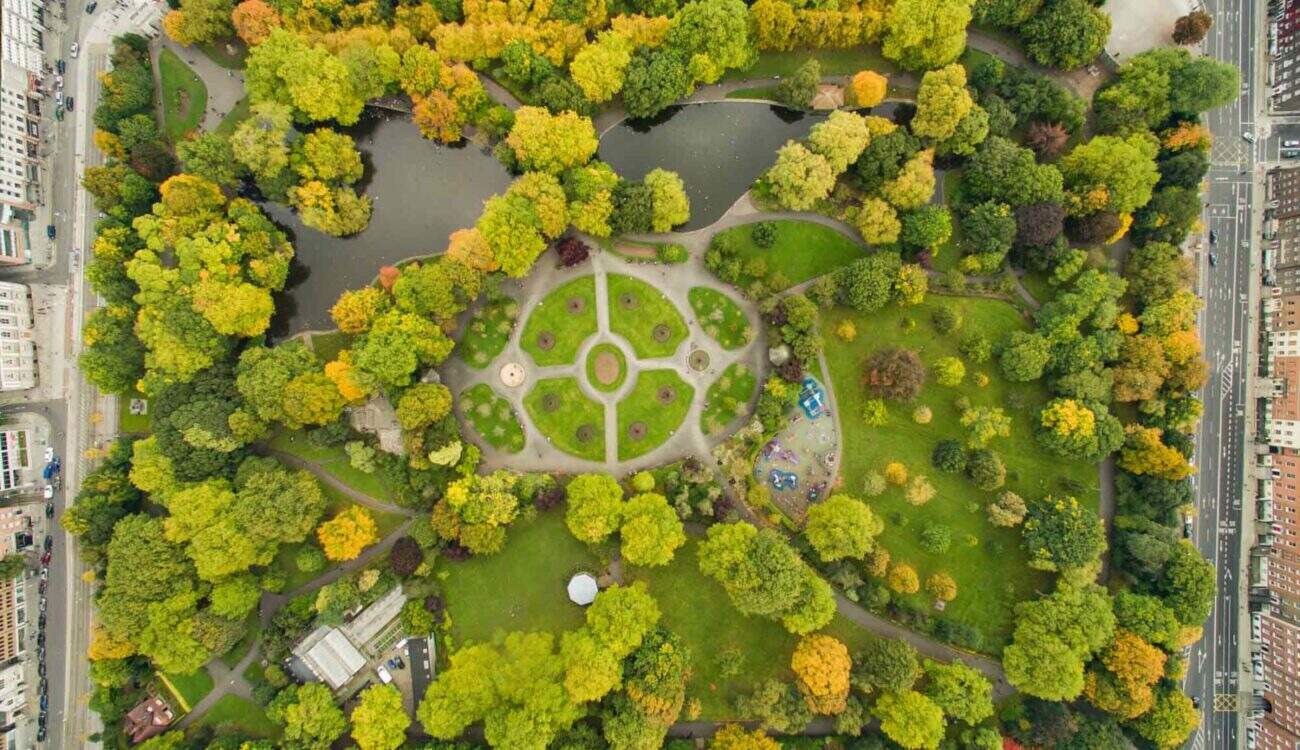
St Stephen’s Green is three minutes on foot from Albany House on Harcourt Street. In spring it becomes one of the most genuinely lovely spots in the city. The daffodils come first, usually in early March, and by April the cherry blossoms are out — frothy pink and white against the deep green of the duck pond, the paths transformed into something unexpectedly beautiful for a public park in a European capital.
The Green is free to enter and open from early morning. The best time to visit is either first thing, before the office workers and tourists arrive, or around the middle of a weekday when it is peaceful enough to actually sit and watch the ducks without feeling crowded. The Victorian bandstand gets used for summer concerts, and the children’s playground at the north end is popular with families. It is a proper park — lived in, used, not just decorative.
Iveagh Gardens, two minutes from the guesthouse, is the Green’s quieter cousin. Tucked behind the National Concert Hall, it is the park that Dubliners recommend to each other but that visitors sometimes miss. It has a cascade, a rustic grotto, a maze of yew hedges, and the sort of hush that makes it feel removed from the city even though it is entirely within it. In spring it is particularly good — the rose garden is not yet in bloom but the trees are leafing up and the lawns are a sharp, almost electric green after winter.
Grafton Street and the outdoor terraces
By April, the outdoor terraces on Grafton Street and the surrounding lanes are back in business. This matters more than it sounds — Dublin has a strong café and brunch culture that essentially lives outside when the weather permits, and in spring you can feel the whole city recalibrating toward that. South William Street, Drury Street, and the little stretch of Exchequer Street all have places worth stopping at.
Camden Street, two minutes from the guesthouse, is where a lot of the best eating and drinking in the city happens. The terraces here open early in spring too. There is a particular pleasure in sitting outside on Camden Street on a Saturday morning with a coffee and nowhere to be, watching the city wake up. It is the kind of neighbourhood that rewards slow mornings.
Grafton Street itself is best visited in spring before the summer crowds. The street performers are out, the flower stalls at the top are fragrant, and you can actually move. Bewley’s Oriental Café is halfway down — a Dublin institution in a magnificent building that is worth stepping into regardless of whether you want coffee.
Festivals in April and May
Spring is when Dublin’s festival season begins in earnest, and the two months of April and May have a particularly strong programme.
One Dublin, One Book runs through April. The idea is simple: everyone in the city is encouraged to read the same book, chosen for its connection to Dublin, with accompanying readings, walking tours, interviews, and events spread across the month. It is low-key in the best sense — the kind of festival you can dip in and out of without having to plan much in advance.
The Dublin Dance Festival runs from 30 April to 16 May 2026, with world premieres, Irish and international performers, free outdoor events, and screenings across various city venues. The programme mixes classical and contemporary dance and includes club nights, movement workshops for all levels, and an artist talks series. It is one of the more ambitious festivals in the city’s calendar and, because it uses stages across the city rather than a single venue, you are likely to walk past something interesting almost by accident.
Bloomsday — the annual celebration of James Joyce’s Ulysses on 16 June — is technically just outside the spring window, but April and May are when the city starts warming up for it. Walking tours of Joyce’s Dublin run all spring, and visiting the James Joyce Centre on North Great George’s Street is worthwhile at any time of year. If you are remotely interested in literature, spring is a good moment to engage with Dublin’s literary history before the full Bloomsday circus arrives.
The parks themselves host music through spring. St Anne’s Park in Raheny gets outdoor concerts later in the season, and smaller gigs happen in various spots around the south city. Check local listings closer to your visit, as the programme changes year on year.
Visiting the main attractions before the summer crowds
This is the practical case for a spring visit: the major attractions are significantly quieter in April and May than they are from June onwards. Trinity College and the Book of Kells in particular get extremely busy in summer. In April you can walk around the cobbled grounds of Trinity at a reasonable pace, and the Long Room — one of the most extraordinary library interiors in the world — can be appreciated without the crush.
The National Museum of Ireland on Kildare Street (free entry) houses the Ardagh Chalice, the Tara Brooch, and early medieval Irish gold that is among the finest of its kind anywhere — ten minutes on foot from Albany House. The Natural History Museum on the same street has barely changed since the Victorian era and has a particular atmosphere unlike anywhere else in the city.
The National Gallery on Merrion Square is a ten-minute walk and has free admission to the permanent collection. In spring it is quiet enough to move easily between rooms, and the walk there and back is pleasant in good weather.
For a change of scene, the coastal villages of Dún Laoghaire, Dalkey, and Killiney are worth a DART journey south. The coastal path from Dún Laoghaire to Dalkey is one of the better walks in the Dublin area, and the bay views on a clear spring day are properly spectacular.
Practical tips for a spring visit
Book accommodation early if you are coming for a bank holiday weekend. Easter (6 April 2026) sees the city fill up, and prices and availability tighten around that period. Mid-April through May is generally easier to find good availability, and the city is more relaxed for it.
Public transport in Dublin is decent. The Luas Green Line runs directly past Albany House on Harcourt Street — there is a stop right at the door — giving you quick access to St Stephen’s Green, Grafton Street, and the Brides Glen direction. Dublin Bikes has docking stations throughout the south city and is an excellent way to cover ground on a dry day.
Walk when you can. Dublin 2 is a compact, walkable area. From Harcourt Street you can reach Trinity College in twelve minutes, the National Museum in eight, Merrion Square in ten, and the GPO on O’Connell Street in twenty. The city rewards people who explore on foot, and spring — mild, long-eveninged, uncrowded — is the best time to do it.
Albany House: a spring city break base
Albany House at 84-85 Harcourt Street occupies a pair of restored Georgian townhouses in Dublin 2. It is part of the Byrne Hotel Group and sits in what is arguably the best location in the city for accessing both the main attractions and the kind of neighbourhood life that makes Dublin worth visiting on repeat.
St Stephen’s Green is three minutes on foot. Grafton Street is five. Camden Street — with its restaurants, coffee shops, and pubs — is two minutes. The Luas Green Line stop is at the door. Packages are available for weekend breaks, and full arrival and travel information is on the website. Get in touch to check availability for your spring dates, or read more about Albany House before you book.
April and May in Dublin are, genuinely, the best-kept secret about this city. Come before the summer crowds and see it at its best.


