


Your First Night in Dublin: A Practical Guide for American Visitors
You’ve made it. The flight took somewhere between six and seven hours, you crossed an ocean, and now you’re standing in Dublin Airport wondering what happens next. This is for you — not a tourist brochure version of Dublin, but the practical, honest guide that a local friend would give you over a coffee.
Getting from the Airport to Harcourt Street
The simplest option, and the one most Americans use, is the Aircoach 700. It runs from both terminals at Dublin Airport directly into the city centre, 24 hours a day, seven days a week, with departures up to every 15 minutes. No pre-booking required — just buy your ticket at the airport or online. The journey takes roughly 30 to 45 minutes depending on traffic.
The stop you want is Leeson Street Lower, which is the closest Aircoach stop to Harcourt Street. From there, it’s a five-minute walk south along Leeson Street to Albany House at 84–85 Harcourt Street. If you’ve landed during the day and you’re fresh off a transatlantic flight with a suitcase in tow, that short walk is actually a blessing — it wakes you up a little and gives you your first look at Georgian Dublin.
If you’d prefer to go straight to the door, taxis and Ubers are plentiful at the airport. Expect to pay around €25–35 depending on traffic. Most drivers take card.
One thing to note: Dublin is a contactless city. Nearly everywhere accepts Visa and Mastercard tap payments — you’ll rarely need cash. It’s worth having a small amount of euro for the odd café or market stall, but you can get through an entire trip without visiting a currency exchange. If you do need cash, ATMs at the airport give a reasonable rate.
Checking In at Albany House
Standard check-in at Albany House is from 2pm. If your flight lands at 7am and you’re standing on Harcourt Street by 9am, don’t worry — the team will store your luggage securely so you can head out and explore without dragging a suitcase behind you. Just let them know when you arrive.
Albany House is a Georgian guesthouse — one of the city’s classic redbrick townhouses on one of Dublin’s finest streets. It has a lift, so you won’t be hauling bags up Victorian staircases. The rooms are comfortable and well-equipped, and there’s free Wi-Fi throughout.
One practical note for your first morning: breakfast at Albany House is available as a paid option, not included automatically in your room rate. It’s worth having — a proper Irish cooked breakfast sets you up well — but factor it into your planning. Full details are on the FAQ page.
The First Walk: Orient Yourself
Even if you’re exhausted, resist the urge to go straight to your room and sleep. Here’s why: if you crash at noon Dublin time, you’ll wake up at 8pm feeling terrible and you’ll be useless for three days. The best thing you can do for your body clock is stay moving.
Step outside Albany House and turn left. In three minutes you’ll reach St Stephen’s Green — Dublin’s central park, 22 acres of grass, ducks, fountains, and people eating their lunch. Walk around it. It takes about 20 minutes at a slow pace. This does something useful: it tells your body that it’s daytime, it gets you into natural light (crucial for resetting your internal clock), and it gives you a sense of where everything is.
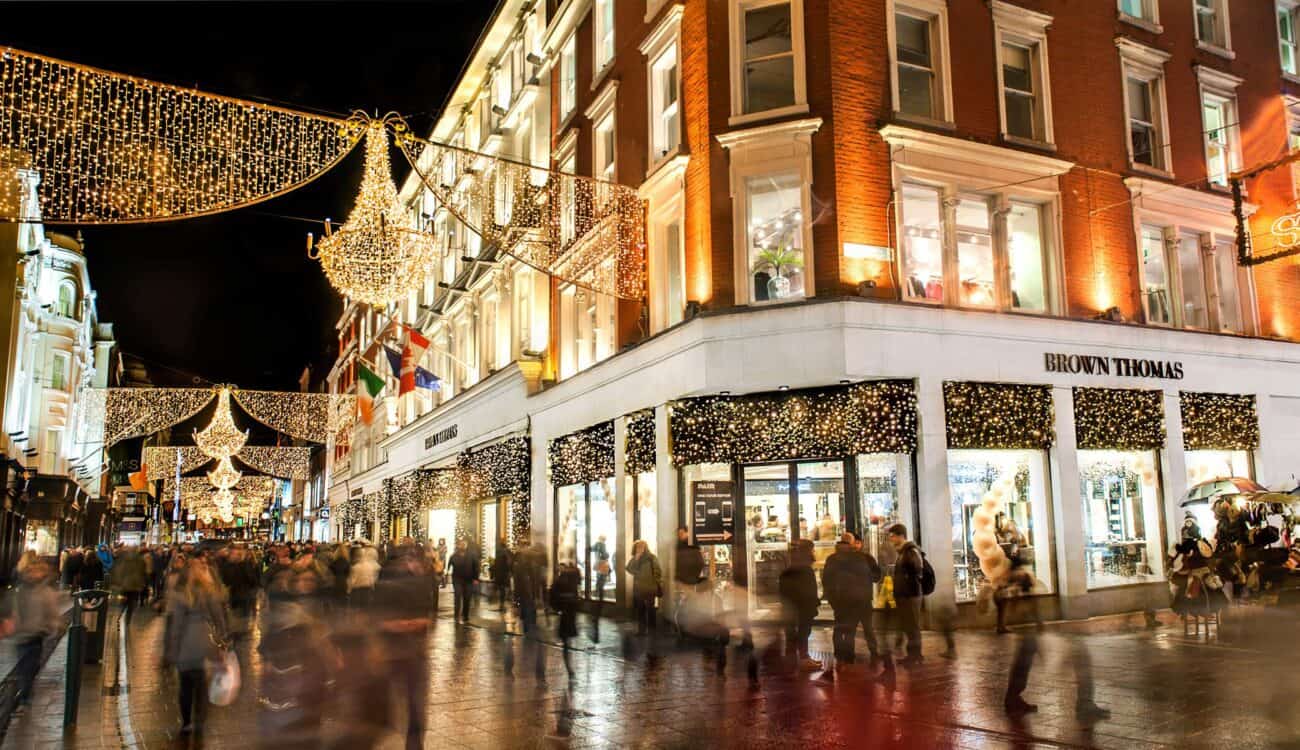
From the Green, it’s a five-minute walk north along Grafton Street — Dublin’s main pedestrian shopping street. On any given afternoon there are buskers performing everything from classical violin to traditional Irish music. Stop for a coffee. There are plenty of independent cafés along the side streets; Bewley’s on Grafton Street is a Dublin institution if you want something with a bit of history and atmosphere.
You don’t need to do anything in particular on this first walk. The point is simply to arrive — to get your bearings, see the city in daylight, and feel like a person again after the flight.
Your First Meal in Dublin
By the time you’ve walked around, you’ll be hungry. Albany House sits at the top of Camden Street, two minutes on foot, which is genuinely one of the best streets for eating in the city. It’s where Dubliners eat — not a tourist strip.
Uno Mas on Aungier Street does excellent Spanish-influenced small plates and is good for an early dinner. The Lucky Duck, also on Aungier Street, is a Victorian-style pub and neighbourhood bar with solid food and a warm atmosphere. Both are within five minutes of Albany House.
If you’d rather ease in with a pint before deciding on food, Whelan’s on Wexford Street and Devitt’s on Camden Street are proper Dublin pubs — none of the tourist-pub theatrics, just good Guinness and a relaxed crowd. Whelan’s is also one of the city’s best live music venues, so check what’s on that evening.
One cultural note for American visitors: tipping in Dublin pubs is not expected or required. You don’t tip at the bar. In restaurants, 10 to 15 per cent is appreciated for good service but it is genuinely optional — unlike in the US, it won’t raise eyebrows if you don’t. Nobody will chase you to the door.
Jet Lag: The Honest Guide
Most transatlantic flights from the east coast of the US arrive in Dublin in the early morning, Irish time. Dublin is five hours ahead of Eastern Time and eight ahead of Pacific. That means your body thinks it’s the middle of the night when the sun is already up.
Here is what actually works:
- Stay outside in natural daylight as much as possible on day one. Light is the primary signal your body uses to reset its clock. Dublin in summer has extraordinarily long evenings — it doesn’t get dark until after 10pm in June and July. That extended daylight is your friend.
- Push through until at least 9pm Irish time before sleeping. It will be hard. Do it anyway. The walking will help tire you out legitimately rather than the artificial fog of jet lag.
- Avoid heavy alcohol on day one. A pint is fine; a session is not. Alcohol disrupts sleep quality and will make the second day considerably worse.
- Don’t nap. A 20-minute rest if you genuinely can’t function is acceptable, but a two-hour sleep in the afternoon will leave you wide awake at 3am.
Most people find that after one solid night’s sleep in Dublin time, they feel largely functional. By day three, the jet lag is a memory.
Practical Bits: Phone, Weather, and Money
Phone: Most major US carriers — T-Mobile, Verizon, AT&T — now include EU roaming in their standard plans, often at no extra charge. Check your plan before you travel and you may find you don’t need to do anything at all. Albany House has free Wi-Fi throughout if you’d rather keep your data usage down.
Weather: You’ll have heard that Ireland is rainy. This is true, but it’s rarely miserable in the way a heavy summer storm back home can be. Irish rain tends to be light and persistent — a fine drizzle that comes and goes throughout the day. The temperature in Dublin is mild year-round: rarely below 3°C in winter, rarely above 22°C in summer. Pack a waterproof jacket (not an umbrella — Dublin’s wind makes umbrellas useless) and layers. You’ll be fine.
Currency: Ireland uses the euro. The approximate exchange rate hovers around $1.10 per euro, though check the current rate before you travel. Contactless payments are accepted everywhere — supermarkets, pubs, taxis, market stalls. Most places have a small minimum for card payments, so carry a few euro in coins for very small purchases.
Day Two: A Suggested Plan
Once you’ve had a proper night’s sleep, Dublin opens up properly. Here’s a solid second day:
Morning — Book of Kells at Trinity College. One of the genuinely unmissable things in Dublin. The illuminated manuscript is extraordinary up close, and the Long Room — one of the most beautiful library interiors in the world — is breathtaking. Go early; it gets busy by mid-morning. Book your tickets online in advance — there are often queues for walk-in visitors. Trinity is a 12-minute walk from Albany House.
Afternoon — National Museum of Ireland. Free entry, and the collection of Iron Age and Viking artefacts is world-class. The Ardagh Chalice and the Tara Brooch alone justify the visit. It’s on Kildare Street, right beside the National Gallery (also free).
Late afternoon — Kilmainham Gaol. If you have any interest in Irish history, this is essential. The 19th-century prison where the leaders of the 1916 Rising were executed is one of the most atmospheric historic sites in the country. Book your tour online well in advance — it regularly sells out, especially in summer. A 25-minute walk from Albany House or a short Luas ride.
By day two, Dublin will have started to feel familiar. The streets will make sense, you’ll know where to get a good coffee, and you’ll have begun to understand why people fall in love with this city.
If you’re still sorting your accommodation in Dublin 2, Albany House is right in the middle of all of it — three minutes from St Stephen’s Green, walking distance from everything in this guide. Have a look at our rooms, check the packages page, or get in touch and we’ll look after you from the moment you arrive.


